
What RPM Is My Record? 33, 45 and 78 Explained
12-inch LPs play at 33⅓ rpm, most 7-inch singles at 45, and old shellac discs at 78. Here's how to tell which speed your record actually needs.
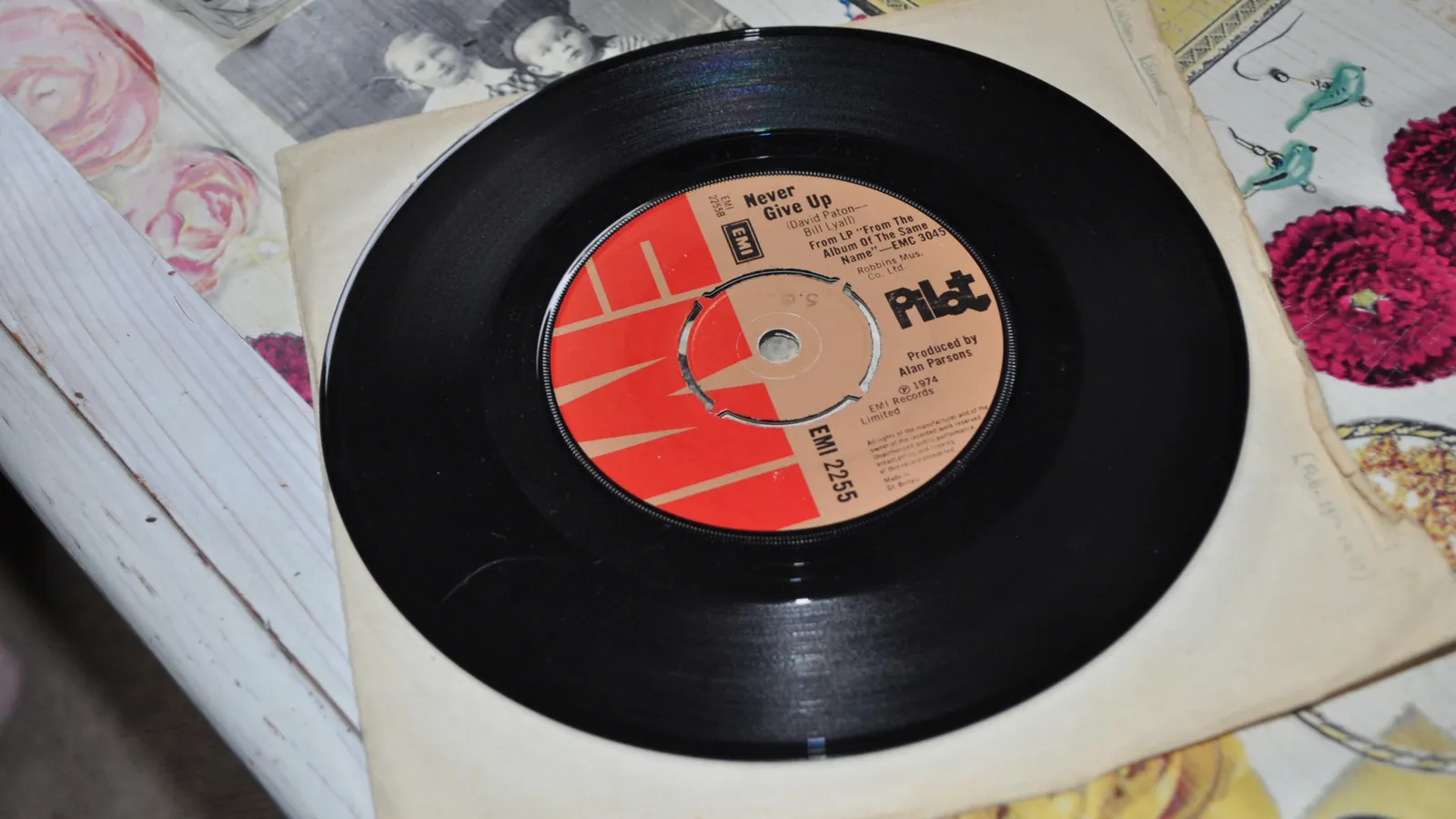

Most 12-inch records play at 33⅓ rpm, most 7-inch singles play at 45 rpm, and older shellac discs play at 78 rpm. Size is the fastest clue, but it's not the only one — some 7-inch EPs run at 33⅓, some 12-inch singles run at 45, and the only fully reliable check is the label, the sleeve, or a Discogs listing.
Here's how to work out a record's speed when it isn't obvious, starting with the size rule and moving through the clues that settle it when size alone doesn't.
Getting it wrong isn't a disaster — it won't damage the record — but it's worth sorting out before you settle in to listen, and essential to know before you catalogue an inherited or second-hand find you don't recognise.
The standard speeds
Three speeds cover almost everything you'll come across, plus one genuine rarity:
- 33⅓ rpm — the standard for LP albums since the format's introduction, and still the default for full-length vinyl today.
- 45 rpm — the standard for most 7-inch singles.
- 78 rpm — the original recorded-music speed, made largely obsolete by the mid-1950s as 33⅓ and 45 took over, according to Yamaha's guide to vinyl.
- 16⅔ rpm — a genuinely rare speed, occasionally used for spoken-word records and some specialist releases; if you come across it, the label will almost always say so.
Rules of thumb by size
Size narrows it down fast, even if it isn't a guarantee:
| Size | Usual speed | Notes |
|---|---|---|
| 12-inch | 33⅓ rpm | The standard album format; roughly 22 minutes per side at this speed. |
| 12-inch | 45 rpm (less common) | Used for some 12-inch singles and audiophile reissues chasing better sound quality. |
| 7-inch | 45 rpm | The standard single format. |
| 7-inch | 33⅓ rpm (less common) | Used for some EPs packing more tracks onto a 7-inch. |
| 10-inch | 78 rpm or 33⅓ rpm | Could be an older shellac 78, or a 33⅓ LP pressed in the less common 10-inch size. |
The 10-inch size is the least reliable to guess from size alone — it genuinely spans two very different eras and materials, which is exactly when the other checks below matter most. A quick weight check helps here too: a shellac 78 in this size is noticeably heavier and more brittle-feeling than a vinyl LP of the same diameter.
Do this in the app:Sleevewise · Scanner
Check the label and sleeve first
Before guessing from physical clues, look for a printed speed — many releases state it directly on the label or the sleeve, particularly for anything that isn't the "default" speed for its size. It's the fastest way to be certain, when it's there. If you can't find it on the physical copy at all, the release's Discogs entry lists the speed as part of its format details, alongside size and whether it's mono or stereo.
Does playing at the wrong speed damage a record?
No. Running a record at the wrong speed changes the pitch and tempo of what you hear, not the physical groove — a brief misplay while you work out the right speed won't harm the vinyl. What matters more is not leaving it running the wrong way for a whole side once you've noticed, less because of any damage risk and more because you're just not hearing the record properly. Once you've confirmed the correct speed, switch and start the side again rather than trying to judge a record by an intentionally mismatched play.
Switching speeds on your turntable
How you actually change speed depends on the turntable. Many belt-drive decks use a manual switch that repositions the drive belt on a stepped pulley, so changing speed means physically moving the belt rather than pressing a button. Direct-drive and newer electronic turntables more often use a simple switch or button, since the motor's speed is controlled electronically rather than by a mechanical step. If your turntable's speed control only shows two positions, 33 and 45, it almost certainly doesn't support 78 at all — worth checking before you assume any deck can handle an old shellac find.
Physical clues when there's no label to trust
A few physical details help when nothing is printed:
- Centre hole size. A 7-inch single with an unusually large centre hole is a strong signal of a 45 rpm pressing built for jukebox-style spindles; many 45s also use this wider hub, sometimes with a snap-out centre for smaller record-player spindles.
- Material and weight. Thick, heavy, brittle discs that feel closer to ceramic than plastic are shellac — a strong sign you're holding a 78, not a vinyl pressing at all.
- General wear pattern and age. A disc that looks and feels genuinely vintage, with a paper-heavy label design, is more likely to be a 78 than a modern reissue at any speed.
Size gets you most of the way there. The label, the hole and the material settle the rest.
The listening test
If you've made a reasonable guess and started playing, your ears will tell you fast whether you guessed wrong: a voice or instrument that sounds too slow and too low in pitch means you're underplaying it — try the next speed up. Too fast and too high in pitch means the opposite — drop down a speed. It's not elegant, but it's a genuinely reliable check, and most turntables make switching speeds a one-button job.
78s need the right equipment
Not every modern turntable actually supports 78 rpm playback. Fluance's guide to record speeds notes that playing 78s properly can require a different needle or a specific turntable alteration, since shellac discs have wider grooves than vinyl. Before you assume a 78 will just work on whatever deck you own, check that it actually offers a 78 rpm speed and the right stylus for shellac — some multi-speed turntables handle all three speeds, but plenty of modern decks only do 33⅓ and 45.
Exceptions worth knowing
A few releases exist specifically to break the "size decides speed" rule on purpose. Audiophile labels sometimes press a full album across two 12-inch discs running at 45 rpm instead of one at 33⅓, on the reasoning that the faster speed and shorter sides per disc allow wider grooves and better sound quality. These are usually labelled clearly as 45 rpm audiophile pressings, precisely because the format is unusual enough that a buyer needs to know before they drop the needle. Spoken-word records, children's records and some promotional pressings are where you're most likely to run into the rare 16⅔ rpm speed, again usually with the speed printed rather than left for the buyer to guess. When in doubt about a specific release, its Discogs entry will list the actual speed in the format details rather than leaving you to work it out from the disc alone.
Frequently asked questions
01What speed do most vinyl records play at?
Most 12-inch LP albums play at 33⅓ rpm, and most 7-inch singles play at 45 rpm. Older shellac discs, largely phased out by the mid-1950s, play at 78 rpm. Size is a strong hint but not a guarantee — always check the label if one is printed.
02How can I tell if my record is 45 or 33 rpm?
Check the label first, since many records print the speed directly. If not, a 7-inch with an unusually large centre hole is often 45 rpm. As a last resort, play it: if it sounds too slow and low-pitched, try the faster speed; too fast and high-pitched, try the slower one.
03Can modern turntables play 78 rpm records?
Not all of them. Many current turntables only offer 33⅓ and 45 rpm. Playing 78s properly generally needs a turntable that offers that speed and, ideally, a stylus suited to shellac's wider grooves, since shellac is a different, more brittle material than vinyl.
Knowing the format before you catalogue it
Speed is one of the details worth logging alongside everything else when you catalogue a record, especially for oddities like 45 rpm reissues or inherited 78s that don't follow the usual size rule — a shelf or a spreadsheet that only records "7-inch" leaves out a detail you'll want the next time you reach for that record. It also matters before you judge a pressing by ear: comparing a 180g pressing against a standard-weight one, or a coloured variant against a black one, only makes sense once you're certain you're playing both at the same speed on the same equipment.
Sources
- Phonograph record — Wikipedia
- Single (music) — Wikipedia
- Here's What You Need to Know About Vinyl — Yamaha Hub
- Vinyl Record Sizes - What does 33, 45, and 78 RPM Mean? — Fluance
Keep digging
Colored Vinyl vs Black: Does It Sound Worse?
Solid and translucent colours generally sound the same as black vinyl today. Marble, splatter and picture discs are the riskier tiers to know.
180g Vinyl vs Standard Weight: Does It Sound Better?
180g and standard records use the same stampers and groove depth. The extra weight adds durability and a premium feel, not automatically better sound.
How to Clean Vinyl Records Safely: Brush, Wet or Machine
A soft brush before every play clears most dust; stuck-on grime needs a wet clean. Here's what conservators recommend, and what to avoid entirely.