
Dead Wax Credits: What RL, Porky, RVG and STERLING Mean
RL is Bob Ludwig, Porky is George Peckham, RVG is Rudy Van Gelder. What the engineer, studio and plant marks in a record's dead wax tell you about a copy.

Initials in a record's dead wax are usually a signature. RL is Bob Ludwig, who cut lacquers at Sterling Sound from 1969 to 1975 and then at Masterdisk. Porky, Pecko or "A Porky Prime Cut" is George Peckham, who began cutting at Apple Studios in London in November 1968. RVG is Rudy Van Gelder, who recorded almost every Blue Note session from 1953 to 1967 and mastered them himself. Stamps such as STERLING, MASTERDISK or TML name the studio where the lacquer was cut; marks such as MPO, QRP or CTH name the plant that pressed the copy.
Read together, they tell you who cut a side, in which room, and where it was pressed. This guide decodes the commonest ones, with run-outs as Discogs contributors have transcribed them. Whether your copy is an early pressing is a separate question, covered in our guide to telling a first pressing from a later one.
How a name ends up in the dead wax
Wikipedia's entry on matrix numbers notes that the run-out can carry "the initials or signature of the disc cutting engineer", and that plants identified their work with "a number, acronym, symbol, or logo". Because the engineer writes on the lacquer, the mark turns up on the records pressed from it.
Independent studios added a stamp. "The records made by the independent mastering engineers often had the stamp of the studio in the deadwax area," Masterdisk's owner Scott Hull told The Vinyl District in April 2011, and "most of us put our initials or mark on the disk next to the stamp." Hence the two-part credit on so many American run-outs: a studio, then a person.
Hull also explains why one album can carry different names in different countries. For artists with a sales record, the independent engineer would "cut all of the parts to satisfy the pressing needs for the US and sometimes for the entire world". For lesser-known acts, he cut only the first set of masters, and tape copies went abroad, where "a local mastering engineer would cut that country's master". A British and an American copy of the same LP can carry two different signatures, and both are genuine.
Dead wax marks at a glance
| Mark in the run-out | Who or what | What it tells you |
|---|---|---|
| RL (also "rL") | Bob Ludwig, at Sterling Sound, then Masterdisk | Ludwig cut that side's lacquer |
| A PORKY PRIME CUT, PORKY, PECKO, PECKO DUCK | George "Porky" Peckham, British engineer, Apple Studios from 1968 | Peckham cut that side |
| RVG, RVG STEREO, VAN GELDER | Rudy Van Gelder, Hackensack then Englewood Cliffs, New Jersey | Van Gelder cut the lacquer himself |
| KPG@CA | Kevin Gray at Cohearent Audio (CA), his room since 2010 | Gray's cut; the letters after @ name the room |
| STERLING + initials (TJ, GC, TC, RKS); "SS" on early cuts | Sterling Sound, New York, founded 1968 | Cut at Sterling; the initials name the engineer |
| MASTERDISK + initials (RL, HW, GC, TD, SH) | Masterdisk, New York, under that name since 1973 | Cut at Masterdisk; the initials name the engineer |
| TML, TML-M, TML-S, TML-X | The Mastering Lab, founded by Doug Sax in Hollywood in 1967 | Cut at TML; the letter names the lathe |
| MASTERED BY CAPITOL + Wly, KP | Capitol's own mastering rooms, from around October 1973 | Cut at Capitol; the etching names the engineer |
| Bell Sound, in cursive | Bell Sound Studios, New York, 1950–1978 | Lacquer cut at Bell Sound |
| Frankford/Wayne, or F/W | Frankford/Wayne, Philadelphia from 1966, New York from 1973 | Cut at Frankford/Wayne |
| TOWNHOUSE, TOWN HOUSE | Townhouse Studios, west London, 1978–2008 | Cut at Virgin's Townhouse |
| ƱTOPIA, or the lyre alone | Utopia Studios, London, 1976–1992 | Cut at Utopia |
| MPO | MPO, Averton (Mayenne), France, since 1957 | Pressed or plated at MPO |
| QRP | Quality Record Pressings, Salina, Kansas, since 2011 | Pressed at QRP |
| RTI, or a job number ending (1), (2) or (3) | Record Technology Inc., Camarillo, California, since 1974 | Plated at RTI |
| B + year letter + five digits, e.g. BJ78101-01 | Optimal Media, Germany | Pressed at Optimal, and the year of the job |
| -XXXX- stamped, or a Pallas Athene head | Pallas, Diepholz, Germany, since 1948 | Pressed at Pallas |
| Six digits + format letter, "GZ Vinyl" | GZ Media, Loděnice, Czech Republic | Pressed at GZ, and in which format |
| CTH, CT or T | Columbia's plant in Terre Haute, Indiana, 1953–1982 | Pressed at Terre Haute, often for other labels |
The engineers: RL, Porky, RVG and KPG
Bob Ludwig (RL). Ludwig was vice-president at Sterling Sound, then vice-president and chief engineer at Masterdisk, and founded Gateway Mastering in Portland, Maine, in December 1992. He retired in 2023 with 7,892 credits on Discogs, according to Wikipedia. His most famous RL is on Led Zeppelin II. As Tracking Angle tells the story, his 1969 lacquers reached Monarch (MO), Presswell (PR) and Columbia's Pitman plant (P), as well as the UK and Germany, before Atlantic recalled the album and had it recut at Atlantic Studios "with bass attenuated and dynamics somewhat compressed". Other US copies on Discogs show "AT", the scribe of Atlantic Studios, and no RL. Ludwig's own test pressing sold for $35,000 in December 2024, according to Led Zeppelin News; our guide to test pressings, promos and white labels tells that part.
George Peckham (Porky, Pecko). Born in 1942, Peckham joined Apple Studios in November 1968, where, Wikipedia notes, he "began adding short messages on the run-out grooves of records he mastered". The UK first pressing of John Lennon's Imagine has "Porky" on one side and "Pecko" on the other, according to JPGR's Beatles Pages; UK copies of Led Zeppelin IV read "Pecko Duck" on side A and "Porky" on side B.
Rudy Van Gelder (RVG, VAN GELDER). He recorded in his parents' house in Hackensack from 1946, then in a purpose-built studio in Englewood Cliffs from 1959. Wikipedia stresses that he controlled "the entire recording and post-recording process (excepting the pressing of the records themselves)", with "a small 'RVG' inscribed into the run-out area" as his hallmark. Discogs lists "RVG", "RVG STEREO" and "VAN GELDER" stamps, on records for Blue Note, Prestige, Savoy, Impulse!, Verve and CTI. Original Blue Notes carry a second mark, a cursive "P" or "ear" for Plastylite, the plant that pressed them, according to Jazz Collector.
Kevin Gray (KPG). "It's hard to think of a currently active mastering engineer whose initials appear on more LP lead-out grooves," SoundStage! Experience wrote in 2023. His Discogs profile gives his signature as KPG plus the room, such as ATM for AcousTech, at RTI's plant in Camarillo, and CA for Cohearent Audio, his own room since 2010. Gray cuts Blue Note's Tone Poet reissues, announced in January 2019 as mastered by him and pressed at RTI. Analogue Productions' 2013 reissue of Sonny Rollins' Saxophone Colossus reads "PRLP-7079-A KPG @ CA QRP KEVIN GRAY".
The studio stamps: STERLING, MASTERDISK, TML and Capitol
Masterdisk. Hull's rule is the most useful thing to know about stamps: "Every part that was cut at Masterdisk, has the MASTERDISK stamp impression. Every one." So "if you are looking at a record that was mastered by Bob Ludwig, or Howie Weinberg, Tony Dawsey, Scott Hull or Andy VanDette and it doesn't have that stamp — the master was cut by some other studio and ALWAYS from a tape copy, not the original master." Side A of a 1991 US pressing of Nirvana's Nevermind, mastered by Weinberg, reads "MASTERDISK DGC-24425-A-GL1" on Discogs.
Sterling Sound. Founded in October 1968 by Lee Hulko and Joe Paschek, Sterling hired Ludwig in 1969. Its Discogs profile notes a small "SS" on cuts from the end of 1969, before a stamped STERLING appeared, followed by the engineer's initials: TJ for Ted Jensen, GC for Greg Calbi, TC for Tom Coyne. A 1969 US Led Zeppelin II pressed at Terre Haute reads "T ST-A-691671 RL SS"; Acoustic Sounds' 2020 reissue of John Coltrane's A Love Supreme reads "RKS STERLING", for Ryan Smith.
The Mastering Lab. Doug Sax opened it in Hollywood on 27 December 1967. According to Discogs, its first Scully lathe stamped TML; after a second arrived in 1972 they became TML-M and TML-S, master and slave, and a later Neumann stamped TML-X. The lathes were linked, so S and X cuts were made "literally at the same time" as M cuts: the letter marks a variant, not a different master, and a 1979 US pressing of Pink Floyd's The Wall mixes all three. Sax died in April 2015, and the studio now belongs to Acoustic Sounds in Salina, Kansas; its 2026 Analogue Productions pressing of Van Morrison's Astral Weeks reads "TML-M MCL", for engineer Matthew Lutthans.
Capitol. Per Discogs, the MASTERED BY CAPITOL stamp appears from around October 1973, next to an engineer's etching: "Wly" for Wally Traugott, "KP" for Ken Perry. That date is useful: Discogs lists 1973 US copies of The Dark Side of the Moon (Harvest SMAS-11163) with Traugott's "Wly" and no stamp, and others with "MASTERED BY CAPITOL" and Perry's "KP".
Do this in the app:Sleevewise · Collection
British cutting rooms: HTM, Bilbo, Townhouse and Utopia
Peckham had company. Atlas Records' guide to run-out etchings lists HTM for Harry T. Moss of EMI and Abbey Road, found on Revolver and The Dark Side of the Moon; "Bilbo" for Denis Blackham, known for his Bowie pressings; BLAIR'S for Chris Blair, who worked on Abbey Road at 17; "Cookie" for Ian Cooper; "MATT's" for Matt Colton; and a "STRAWBERRY" stamp on many UK pressings of the 1960s and 1970s. The cent sign, ¢, belongs to an American, Tom Coyne, a pun on his surname.
Townhouse, built in west London by Richard Branson and Ian Cooper in late 1978, stamped "TOWNHOUSE" or "TOWN HOUSE" until it closed in April 2008. Utopia Studios, opened in London in October 1976, marked its cuts with a lyre, often written "ƱTOPIA"; Cooper cut there from 1976 to 1979.
Plant marks: where your copy was pressed
Engineers sign lacquers; plants mark the metal parts and the pressings. Discogs' plant profiles describe these:
- MPO, France. The plant founded in Averton, Mayenne, in 1957 usually hand-etches "MPO". Since about 2017 it has laser-etched a logo and a stamper number whose first two digits give the year. The group also runs MPO Iberica in Madrid.
- QRP, United States. Quality Record Pressings stamps QRP beside the engineer's mark, as on the Saxophone Colossus above.
- RTI, United States. Record Technology Inc. writes its plating job as "xxxxx.1 (3)": a number, the side, and (1), (2) or (3) for the plating process. Discogs warns that a record plated at RTI was not necessarily pressed there.
- Optimal Media, Germany. A code such as BJ78101-01: B for vinyl, then a letter for the year, J for 2019, Q for 2026.
- Pallas, Germany. A four- or five-digit number between hyphens, or the head of Pallas Athene.
- GZ Media, Czech Republic. A machine-engraved six-digit number, then a format letter (E for a 12-inch at 33⅓, M at 45) and the side. Our GZ Media profile has the plant's story.
- CTH, United States. Columbia's Terre Haute plant stamped CT, CTH or a T, including on records it pressed for Atlantic, Capitol and A&M.
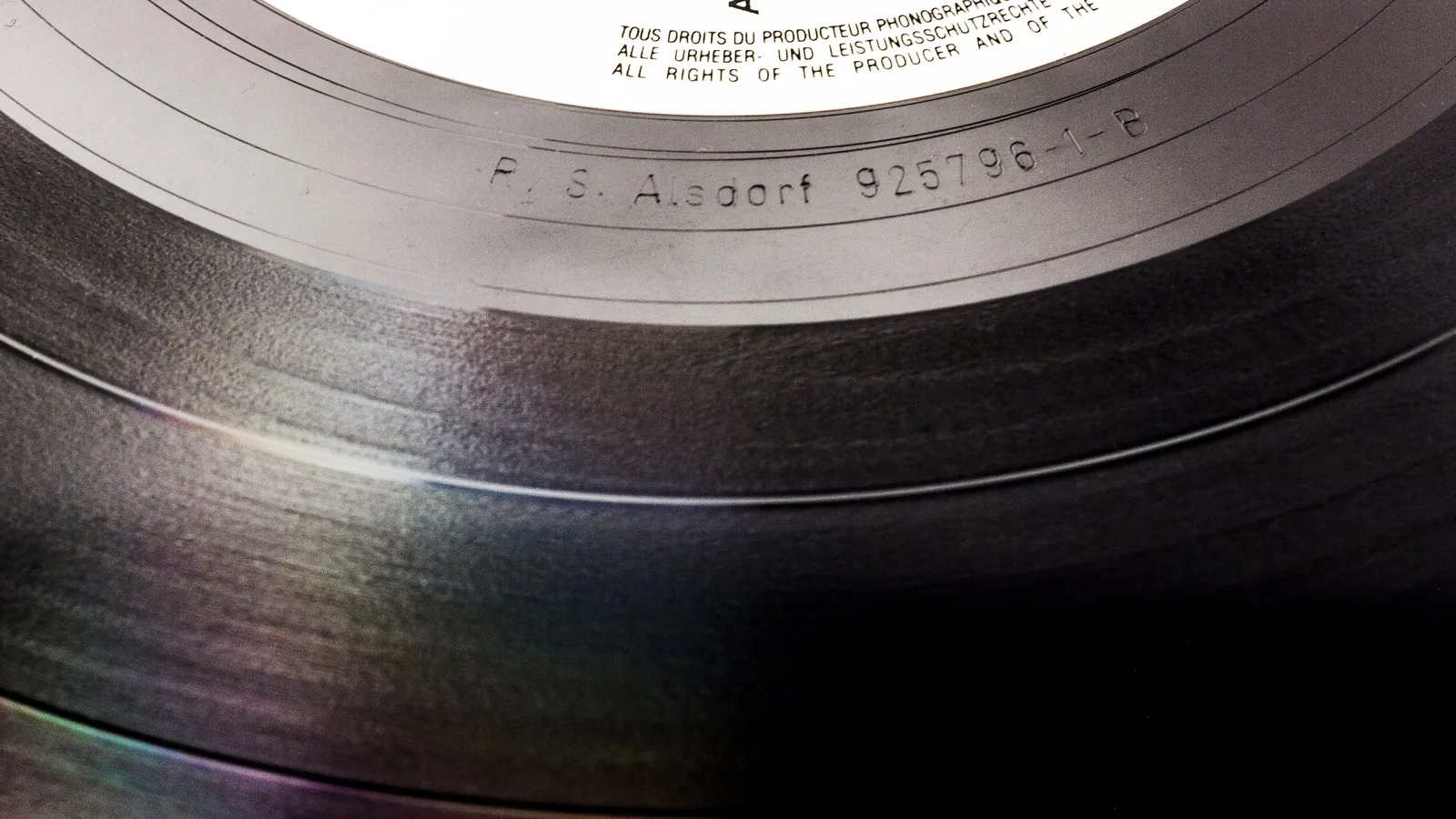
The run-out in the photo at the top reads "R. S. Alsdorf": Record Service, the plant in Alsdorf, Germany, that pressed for WEA. Absence proves little, though: Optimal's own profile notes that records without its code may still have been pressed there.
What a signature tells you, and what it doesn't
Put the pieces together and a line of dead wax becomes a credit list. Take the Led Zeppelin II run-out above, "T ST-A-691671 RL SS": T for Columbia's plant in Terre Haute, ST-A-691671 for the side's matrix number, RL for Ludwig, SS for Sterling Sound.
A signature in the dead wax tells you who cut the lacquer and where, never on its own when your copy was pressed.
Three cautions follow. A signature dates the lacquer, not the pressing: KPG sits on a 2013 reissue of a Prestige album recorded in Hackensack, TML-M on records pressed in 2026. Initials alone can be ambiguous: GC is Greg Calbi at both Sterling and Masterdisk, and only the stamp beside it names the room. And a famous name doesn't make a first pressing: the run-out still has to agree with the label and the catalogue number.
Frequently asked questions
01What does RL mean in the dead wax of a record?
RL is the signature of mastering engineer Bob Ludwig, who etched his initials into lacquers he cut at Sterling Sound from 1969 to 1975 and then at Masterdisk. On Led Zeppelin II it marks his original 1969 cut, which Atlantic withdrew and had recut.
02What is A Porky Prime Cut on a vinyl record?
It is the signature of George Peckham, a British cutting engineer nicknamed Porky, who started at Apple Studios in 1968. Porky, Pecko and Pecko Duck in the run-out all mean he cut that side's lacquer.
03What do STERLING or MASTERDISK stamped in the run-out mean?
They are the stamps of two New York mastering studios and show where the lacquer was cut; initials next to the stamp name the engineer, such as STERLING TJ for Ted Jensen. According to Masterdisk's Scott Hull, a master by one of its engineers without the stamp was cut elsewhere from a tape copy.
Keeping the run-out with the record
Copy the run-out exactly, side by side, with every stamp, symbol and crossed-out character: it names the people who made the record, and often separates two copies with identical labels. It belongs with the other identifiers when you catalogue the exact release.
When you match a pressing by its run-out in Sleevewise, it names the mastering engineers, cutting studios and pressing plants it recognises in the inscriptions, and the run-out is kept in that copy's notes. The vinyl collection app handles the rest, from the barcode and cover scanner to Goldmine grading.
Sources
- TVD's On the Record with Masterdisk's Scott Hull — The Vinyl District, 8 April 2011
- Matrix number — Wikipedia
- Bob Ludwig — Wikipedia
- George Peckham — Wikipedia
- Rudy Van Gelder — Wikipedia
- Kevin Gray (engineer) — Wikipedia
- Bob Ludwig's Led Zeppelin II Test Pressing Goes to Heritage Auction — Tracking Angle, 31 October 2024
- Bob Ludwig's Led Zeppelin II hot mix test pressing sold for $35,000 — Led Zeppelin News, December 2024
- John Lennon, Imagine (PAS 10004) — JPGR's Beatles Pages
- Twelve Tips To Collecting Blue Note — Jazz Collector, 23 September 2009
- An Interview with Mastering Engineer Kevin Gray — SoundStage! Experience, June 2023
- Blue Note Presents the Tone Poet Audiophile Vinyl Reissue Series — Blue Note Records, 23 January 2019
- Understanding Matrices: What are the Etchings at the End of a Record? — Atlas Records, 8 December 2022
- Engineer profiles: Bob Ludwig, George Peckham, Rudy Van Gelder, Kevin Gray — Discogs
- Studio profiles: Sterling Sound, Masterdisk, The Mastering Lab, Capitol Mastering, Atlantic Studios, AcousTech Mastering, Cohearent Audio, Bell Sound Studios, Frankford/Wayne Recording Labs, The Town House, Utopia Studios — Discogs
- Plant profiles: MPO, Quality Record Pressings, Record Technology Incorporated, Optimal Media GmbH, Schallplattenfabrik Pallas, GZ Media, Columbia Records Pressing Plant, Terre Haute, Record Service Alsdorf — Discogs
- Run-outs as transcribed on Discogs: Led Zeppelin II, US 1969, Led Zeppelin II, US, cut at Atlantic Studios, Led Zeppelin IV, UK 1971, Sonny Rollins, Saxophone Colossus, 2013, Nirvana, Nevermind, US 1991, John Coltrane, A Love Supreme, 2020, Pink Floyd, The Wall, US 1979, Van Morrison, Astral Weeks, 2026, Pink Floyd, The Dark Side of the Moon, with Wly and with MASTERED BY CAPITOL — Discogs
Keep digging
How to Tell If a Record Is a First Pressing
No single clue proves a first pressing. Matrix numbers, labels and catalogue numbers have to agree — here's how to read each one properly.
How to Spot Counterfeit Vinyl Records Before You Buy
Blurry artwork, a pixelated barcode and a runout that doesn't match the catalogue number are the clearest signs of a fake. The full checklist.
Sonopress EcoRecord: 15 PET LP Machines by 2029
Sonopress will run 15 EcoRecord machines by 2029. What these injection-moulded PET records are, how they sound and how to tell if you own one.