
Test Pressing vs Promo vs White Label: How to Tell Them Apart
A test pressing checks the sound before a run, a promo goes to radio and press, a white label has no print. How to tell them apart and what drives their value.
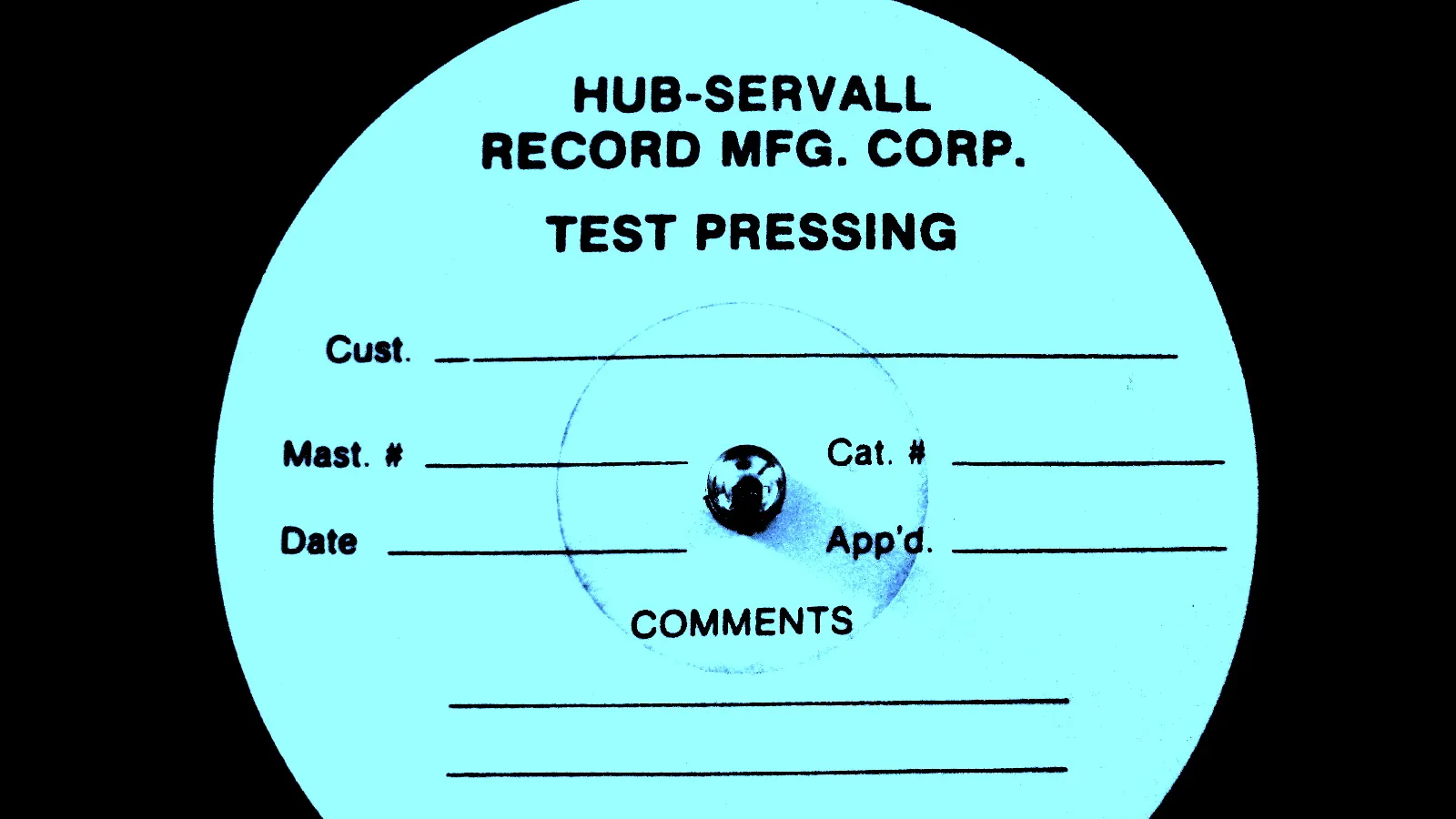
A test pressing is one of the handful of discs a pressing plant makes to check the sound before the full run: usually three to five copies, according to Hellbender Vinyl, or five to ten, according to Atlas Records, often with a plain label and details stamped or written by hand. A promo is a finished record sent to radio, press and DJs in far larger numbers, marked "Promotional", "Demonstration" or "Not For Sale". A white label is not a third kind of record at all: in Discogs' definition, it only means a centre label with nothing printed on it, which can turn up on a test pressing, a promo or a pressing nobody authorised.
The difference matters when you buy, sell or insure. Mastering engineer Bob Ludwig's own test pressing of Led Zeppelin II, on blank white labels, reached $35,000 at Heritage Auctions in December 2024. A promo, on the other hand, is not automatically worth more than a shop copy: the dealer eil.com valued a promo of David Bowie's single with The Manish Boys at £500, and a stock copy at £900.
This guide sets the three side by side, then goes through the tells on the label, in the run-out, on the sleeve and in the paperwork, what drives prices, the legal grey areas, and how to record what you own.
Test pressing, promo and white label: what each one is
Two of these terms describe what a record was made for; the third describes only what its label looks like. That is why one disc can be two of them at once: Ludwig's Led Zeppelin II is a test pressing on white labels.
| Test pressing | Promo | White label | |
|---|---|---|---|
| Made for | Checking the sound before the full run | Airplay, reviews and DJ play ahead of release | Nothing in particular: the term describes the label |
| How many | Usually 3–5 (Hellbender) or 5–10 (Atlas Records) | Larger runs; US white label promos usually a few thousand per title | Anything from a few test discs to a few thousand DJ singles |
| Centre label | Blank, or a plant's "Test Pressing" form filled in by hand or stamp | Retail design marked "Promotional", "DJ copy" or "Demonstration", or a promo-only design | No printed text on either side, whatever its colour |
| Sleeve | Plain: the plant checks sound, not artwork | Usually the retail sleeve, sometimes stamped, stickered or with a timing strip | Often plain |
| Who gets it | Artist, producer, label or plant | Radio, press, DJs and industry staff | Depends on the record |
| Discogs format tag | Test Pressing | Promo | White Label |
The quantities come from the sources in each cell; the US figures from Wikipedia's white label article, which also notes that small labels and DJs pressed club white labels in runs from under 300 copies to a few thousand. The list of recipients for test pressings is Wikipedia's: they are "usually meant for the artist, producer, pressing plant, or record label to keep as reference", and sometimes given to friends or fans in packaging such as a photocopy of the real sleeve.
One neighbour to keep apart: an acetate. Discogs describes acetates as typically coated aluminium with no run-out information that could match a retail version. A test pressing, by contrast, is pressed in vinyl from the stampers themselves.
Reading the label: forms, stamps and promo wording
Test pressings rarely wear the finished label. Atlas Records calls them "plain and utilitarian", with catalogue and matrix numbers sometimes handwritten or stamped rather than printed. A plant may print a form instead: the Hub-Servall label at the top of this page leaves lines for the customer, master number, catalogue number, date and approval. On factory samples shown by the dealer eil.com, studio labels are printed "Factory Sample" and "Made In England", annotated by hand with artist, title, catalogue and matrix details, and state that the record must not be used for review purposes: it is "purely a reference tool".
Some words cut both ways. Discogs points out that the French "échantillon" and the German "unverkäufliche Musterplatte" can mark either a promo or a test pressing; context decides, and a named pressing plant usually means a test pressing.
A promo announces itself in words. Discogs applies its Promo tag when the record says so, with terms such as "Promotional", "DJ copy", "Demonstration", "Audition" or "Plug Side". Goldmine's checklist adds "For Radio-TV Use Only", "Review Copy" and "Not For Sale". In the US, a "white label promo" (WLP) keeps mostly the same text and logo as the retail label, on a white background, which makes it a promo but not a white label in Discogs' sense, since it is printed. From the 1950s to the 1970s, labels also sent out "A-label demos", printed with a large "A" to show which side to play and often the planned release date, according to eil.com.
A true white label, in Discogs' terms, carries no mechanically applied print on either side, and it can be any colour: a white-coloured label is not enough. A rubber stamp, a sticker or handwriting on a blank label counts as a later addition. And a blank label proves nothing on its own: Wikipedia notes that white labels have also carried unlicensed remixes and bootlegs.
Run-out, sleeves and paperwork
The run-out ties a disc to a release. Hellbender defines a test pressing as a small run pressed from the same stampers that will be used for the full production run, and GZ Media's guide asks customers to check the side splits against the matrix numbers. So when the sound is approved, the test pressing should carry the same matrix as the shop copies, and when a promo or test pressing carries no details of its own, Discogs borrows the retail label, catalogue number and tracklist only "if the matrix matches". Ludwig's copy reads "SFA-691671 RL" on one side and "ST-A-691672 RL" on the other, with his initials after each number; our guide to deadwax mastering credits explains marks like these.
When the sound is not approved, GZ Media says any change to the sound, volume or track order needs a new cut, so a test pressing from a rejected cut can carry a run-out that no shop copy has. eil.com adds that test pressings sometimes feature different tracks or mixes from the finished record.
Sleeves are weaker evidence. GZ Media says its test pressings are "intended exclusively for sound quality verification — not for checking artwork or printed parts", and are not used to approve coloured or shaped vinyl, so a plain sleeve is normal. A slight warp is not a red flag either: Hellbender sends its test pressings out without the 24-hour cooling period production runs get, and expects minor warps that won't appear on the final pressing. For promos, Goldmine lists stamps and stickers on covers, notched spines, cut corners, drill holes, lines through barcodes, "Free" punched into the card, and timing strips listing song titles and running times. But Discogs treats retail copies with stamped or stickered covers, cut spines or marked barcodes as the same release as the retail one, since the marks were added after manufacture, and its general rules describe a cut sleeve as a price-cut item. A clipped corner can mean a cut-out as easily as a promo.
Paper is often the strongest proof. The Heritage lot came "directly from Bob Ludwig with the original white paper sleeve sent to him", and Led Zeppelin News describes handwritten notes on it: the date 5 September 1969, the matrix numbers, the catalogue number and "from Pitman", which it reads as Columbia's plant in Pitman, New Jersey. Plants keep their own paperwork too: GZ Media's customers report faults on a Test Pressing Claim Form that quotes the catalogue and matrix numbers. Discogs says a press release or info sheet does not by itself make a separate release, but for a collector it is the record of where a copy came from. Keep it with the disc.
Do this in the app:Sleevewise · Value
Why some are collectable, and what drives the price
Scarcity is a start, not a price. "Scarcity does not always equate to collect-ability," as eil.com puts it, and Atlas Records says a test pressing's value "can vary widely depending on factors like the artist, album, condition, and demand among collectors". Four things do most of the work:
- Demand for the artist and the record. A test pressing of a record nobody looks for is a rare record nobody looks for.
- A difference from the release. A different mix or track, or a release that never happened. Discogs' October 2022 list was topped by a one-sided 7-inch test pressing of Culture Club's "Heaven's Children", meant as the third UK single from From Luxury To Heartache before the release was cancelled. With handwritten details on its label, it sold for $5,172.40.
- Provenance. Ludwig's copy came from his own archive, and it carries his original, louder cut of the album, which Atlantic soon had re-cut "with bass attenuated and dynamics somewhat compressed", as Tracking Angle tells it. Bidding reached $35,000 on 3 December 2024 with 14 bidders, according to Led Zeppelin News, and Heritage's terms add a 25% buyer's premium to the winning bid. For scale, a stock copy of Ludwig's cut, the "Presswell" pressing, was the most valuable record sold on Discogs in July 2026, at $6,081.
- Condition. It still counts at that level: Heritage graded Ludwig's disc EX 7.5 and its jacket VG-EX 6.
Promos follow the same logic, with a twist. Wikipedia's summary is that promos of best-selling records can be worth slightly less or slightly more than a stock first pressing. For some 1960s records the stock copy is the rarer one: eil.com explains that when advance copies met a poor or indifferent reaction, very few copies reached the shops, and gives the Manish Boys single as an example: £500 for the demo, £900 for the stock copy. Where demand is strong, promos fetch real money: in July 2026, two 1967 mono promos, Jimmy Mack's "My World Is On Fire" and The 13th Floor Elevators' Easter Everywhere, sold on Discogs for $2,432 and $2,464.
A test pressing is worth what it documents, not the blank label it wears.
Can you legally sell a test pressing or a promo?
There is no single answer, and this is not legal advice. Hellbender's position on test pressings is blunt: "TPs aren't commercial products - they're manufacturing tools. Selling them can violate copyright law since they're not registered with rights organizations." The factory samples shown by eil.com say on the label that they are for reference, not for review.
Promos have a clearer precedent, in the US at least. In UMG Recordings v. Augusto, the Ninth Circuit Court of Appeals ruled on 4 January 2011 that Universal had transferred ownership of promo CDs it mailed out unsolicited with a "promotional use only", not-for-sale notice, so the man who resold them did not infringe its copyright. According to the EFF, which represented the seller, the court noted that UMG did not keep control of the CDs once mailed, did not require recipients to agree to its conditions and did not ask for them back. The ruling is American and concerns promos given away in that way; it says nothing about test pressings, or about other countries.
In practice, both change hands openly: the Culture Club test pressing above sold on Discogs. But a seller cannot always say how a test pressing left the plant. Before you pay test-pressing money, ask where the copy came from, and keep the answer with the receipt.
Frequently asked questions
01What is the difference between a white label and a test pressing?
A white label only describes the centre label: no printed text on either side. A test pressing is defined by its purpose, checking the sound before the full run. Many test pressings have white labels, but so do some promos and unofficial pressings.
02Is a test pressing worth more than a regular copy?
Often, but not always. The price depends on demand for the artist and the record, its condition, its provenance and what it documents, such as a different mix or a cancelled release. A test pressing of a record nobody collects stays cheap.
03Are promo records worth more than stock copies?
Sometimes. Promos of best-selling records can be worth slightly more or less than a stock first pressing, and for some 1960s records the stock copy is rarer. eil.com valued a Manish Boys demo at £500 against £900 for the stock single.
Recording a test pressing or promo in your collection
Treat the photos and the paperwork as part of the record. For each copy, photograph both labels, both run-outs, the sleeve and any notes or letters, and write down where and when you got it. Then file it under the right release: Discogs gives white labels and promos their own entries rather than folding them into the retail one, and its rules say to tag a record Test Pressing only if it is clearly marked as such. Our guide to cataloguing a record collection covers the other fields worth logging per copy, and the one on first pressings explains why a promo is not what most listings mean by a first pressing.
A one-off test pressing has few or no sales to compare with, which is the case where a professional valuation earns its fee, as our guide to what your records are worth explains.
In Sleevewise, the This copy panel keeps a copy's pressing kind (test pressing, promo or white label) alongside your notes, so the distinction stays in the catalogue rather than in your memory. The value Sleevewise shows comes from the Discogs Marketplace: the lowest price the exact release is currently listed at, an asking price rather than a sale. For a test pressing filed under the stock release, that figure describes the stock record, not your copy. Vinyl record value explains how the figures work, and the vinyl collection app page covers the rest.
Sources
- The Ultimate Guide to Vinyl Test Pressings: What Every Artist Needs to Know — Hellbender Vinyl, 17 December 2025
- What Is A Test Pressing? Everything You Need To Know About Test Pressings — Atlas Records, 25 September 2023
- Test Pressings – Customer Information Guide — GZ Media, updated 31 October 2025
- Record Collecting: Everything You Wanted To Know But Were Afraid To Ask… Part 4: White Labels/Test Pressings — eil.com, 6 May 2020
- Vinyl 101: 5 quick ways to tell the difference between a promo record and stock copy — Goldmine, 15 June 2022
- Database Guidelines 6. Format — Discogs Support, updated 13 July 2026
- Database Guidelines 1. General Rules — Discogs Support, updated 9 June 2026
- White label record — Wikipedia
- Record collecting — Wikipedia
- Bob Ludwig Personally Owned Led Zeppelin II "Hot Mix" Stereo Test Pressing, lot 26423 — Heritage Auctions, auction of 2–4 December 2024
- Bob Ludwig's Led Zeppelin II Test Pressing Goes to Heritage Auction! — Tracking Angle, 31 October 2024
- Bob Ludwig's Led Zeppelin II hot mix test pressing sold for $35,000 — Led Zeppelin News, 4 December 2024
- Top 25 Most Expensive Items Sold on Discogs in October 2022 — Discogs, 7 November 2022
- The Stories Behind Discogs' Most Valuable Record Sales: July 2026 — Discogs, 10 August 2026
- EFF Wins Landmark Ruling Freeing Promo CDs for Resale — Electronic Frontier Foundation, 4 January 2011
Keep digging
Obi Strip Value: A Guide to the Paper Band on Japanese Vinyl
An obi strip is the paper band on Japanese vinyl giving title, price and catalogue number in Japanese. What it says, why it adds value and how to spot fakes.
What Is a Hype Sticker? Value, History and How to Keep One
A hype sticker is the promotional sticker a label puts on a record's shrink-wrap or sleeve. What it tells you, whether it adds value and how to keep it.
Colored Vinyl vs Black: Does It Sound Worse?
Solid and translucent colours generally sound the same as black vinyl today. Marble, splatter and picture discs are the riskier tiers to know.